

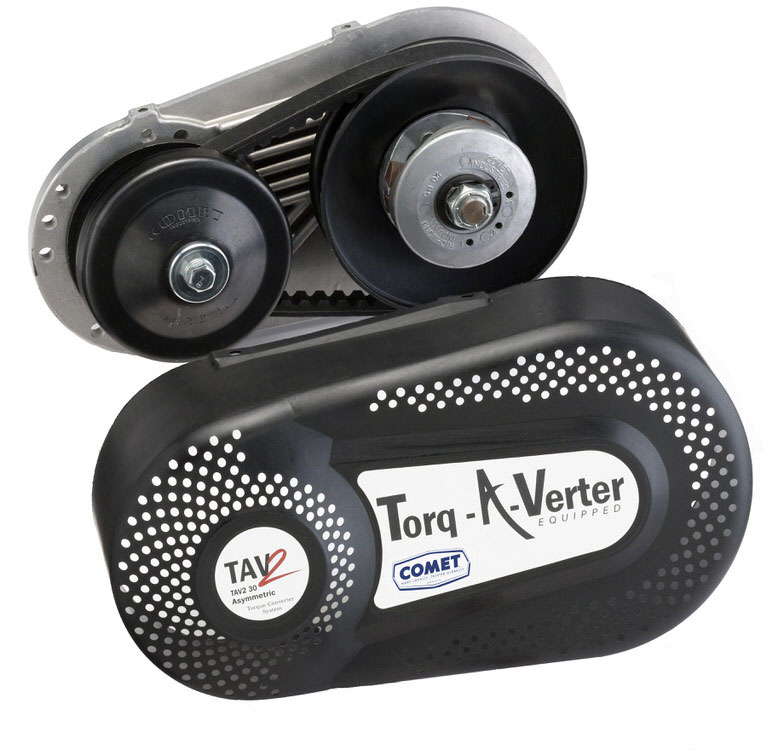
If you're replacing a torque converter belt, driven pulley, or drive clutch on a go-kart, mini bike, or other small vehicle, identifying the correct Comet torque converter series is an important first step. Unfortunately, the series isn't always obvious just by looking at the pulley. One of the most common sources of confusion is the "#20" stamp found on some Comet driven pulleys. Both Comet 20 Series and 30 Series driven pulleys can have this stamp, but the stamp does not identify the torque converter series.
Comet 20 Series vs. 30 Series
The Comet 20 and 30 Series are both commonly used on go-karts, mini bikes, and other recreational vehicles. Both use a 3/4-inch top-width belt, but they use different system configurations.
| Series | Configuration | Belt Width | Status |
|---|---|---|---|
| Comet 20 | Symmetric (V - Shape Belt) | 3/4" | Current |
| Comet 30 | Asymmetric | 3/4" | Current |
Why Correct Series Identification Matters
Torque converter components are not universally interchangeable. The drive clutch, driven pulley, and belt need to be matched to the appropriate system.
Using the wrong belt width or an incompatible pulley can result in improper fitment and poor operation. Before ordering replacement parts, verify:
- Torque converter series
- Symmetric or asymmetric configuration
- Belt top width
- Drive clutch bore
- Driven pulley bore
- Driven pulley diameter
- Pulley mounting orientation
- Engine shaft size and keyway
What About the Older TC88 and CAT99 Series?
- You may also encounter older or obsolete Comet torque converter systems when working on an older go-kart or mini bike.
- The TC88 Series is a symmetric system, while the CAT99 Series is an asymmetric system. Unlike the current 20 and 30 Series, these older systems use a 5/8-inch top-width belt.
